And I – Aleph-Tav, when I am lifted up from the earth, will draw all men to Me. (Jn 12:32 Murdock)


But to Paul the cross was the one object of supreme interest! Ever since he had been arrested in his career of persecution against the followers of the crucified Nazarene he had never ceased to glory in the cross. At that time there had been given him a revelation
 of the infinite love of God, as revealed in the death of Christ; and a marvelous transformation had been wrought in his life, bringing all his plans and purposes into harmony with heaven. From that hour he had been a new man in Christ. He knew by personal experience that when a sinner once beholds the love of the Father, as seen in the sacrifice of His Son, and yields to the divine influence, a change of heart takes place, and henceforth Christ is all and in all. {AA 245.3}
Yesterday (March 22, 2013, better say: Nissan 11, 6,000+ some years after Adam) with my wife we were listening to Rachel Hyman’s song V’ahafta. I said – that’s it – I need to start my presentation about my Beloved Saviour as He revealed Himself to me through His very special name – HaShem Aleph-Tav – Self-denying Servant in Gen 1:1. Before we start, listen with us to this special Bible verse as it is sung by Rachel:
She sings the words from Deuternomy – Davarim (Words) 6:5 and Matthew 22:37-40:
And you shall love the LORD your God with all of your heart, and with all of your soul, and with all of your might – with all of your strength. You shall love your neighbor as yourself. And upon these two Commandments stands the whole Law (Torah): love your neighbor, love your God – V’ahafta!
https://youtube.com/watch?v=MTrFNhNsZVs
I decided to look it up and guess what? Yes, again I found my Beloved Aleph-Tav – “The First & the Last” (Rev 22:13), “The Alpha & Omega” (Rev 1:11), “The Author & Finisher” of our faith… (Heb 12:2), Declaring the End from the Beginning (Is 46:10). But in English Bible you won’t find Him!
Here is how it looks in Hebrew (read from right to left):
ואהבת את יהוה אלהיך בכל־לבבך ובכל־נפשׁך ובכל־מאדך׃
| 157 [e] 5 wə·’ā·haḇ·tā, 5
|
||||
| 853 [e] ’êṯ את – |
| 3068 [e] Yah·weh יהוה the LORD |
| 430 [e] ’ĕ·lō·he·ḵā; אלהיך your God |
| 3605 [e] bə·ḵāl בכל־ all |
| 3824 [e] lə·ḇā·ḇə·ḵā לבבך your heart |
| 3605 [e] ū·ḇə·ḵāl ובכל־ all |
| 5315 [e] nap̄·šə·ḵā נפשך your soul |
| 3605 [e] ū·ḇə·ḵāl ובכל־ all |
| 3966 [e] mə·’ō·ḏe·ḵā. מאדך׃ your might |
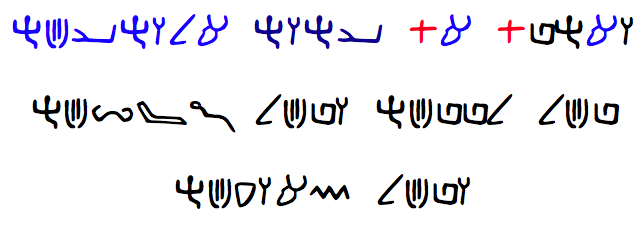


AHAVAH means: BEHOLD YOUR HEAVENLY FATHER – the Inexhaustible Sustainer or Servant of His House
– which includes all creatures in the whole universe – namely you and me! 😉You might already know that Av or Ab means father. So if you want to know what LOVE is you need to TAKE A CLOSER LOOK – BEHOLD your heavenly FATHER’S HEART. That’s why to behold, to worship, to admire is in the middle of the word ABBA

– it’s a picture of the nail, the ox, the man beholding on his knees with his hands lifted towards heaven, the tent and the cross. Together we can read it this way: This FATHER GOD who is LOVE ITSELF (1 Jn 4:8) is Himself nailed to the cross! Please, read this inspired commentary from the book Desires of Ages:
But God suffered with His Son. [you can put the whole sentence in one word-picture: V’ahafta
]. Angels beheld the Saviour’s agony. They saw their Lord enclosed by legions of satanic forces, His nature weighed down with a shuddering, mysterious dread. There was silence in heaven. No harp was touched. Could mortals have viewed the amazement of the angelic host as in silent grief they watched the Father separating His beams of light, love, and glory from His beloved Son, they would better understand how offensive in His sight is sin. {DA 693.2}
Satan with his fierce temptations wrung the heart of Jesus. The Saviour could not see through the portals of the tomb. Hope did not present to Him His coming forth from the grave a conqueror, or tell Him of the Father’s acceptance of the sacrifice. He feared that sin was so offensive to God that Their separation was to be eternal. Christ felt the anguish, which the sinner will feel when mercy shall no longer plead for the guilty race. It was the sense of sin, bringing the Father’s wrath upon Him as man’s substitute, that made the cup He drank so bitter, and broke the heart of the Son of God. {DA 753.2}
With amazement angels witnessed the Saviour’s despairing agony. The hosts of heaven veiled their faces from the fearful sight. Inanimate nature expressed sympathy with its insulted and dying Author. The sun refused to look upon the awful scene. Its full, bright rays were illuminating the earth at midday, when suddenly it seemed to be blotted out. Complete darkness, like a funeral pall, enveloped the cross. “There was darkness over all the land unto the ninth hour.” There was no eclipse or other natural cause for this darkness, which was as deep as midnight without moon or stars. It was a miraculous testimony given by God that the faith of after generations might be confirmed. {DA 753.3}
In that thick darkness God’s presence was hidden. He makes darkness His pavilion, and conceals His glory from human eyes. God and His holy angels were beside the cross. The Father was with His Son. Yet His presence was not revealed. Had His glory flashed forth from the cloud, every human beholder would have been destroyed. And in that dreadful hour Christ was not to be comforted with the Father’s presence. He trod the wine press alone, and of the people there was none with Him. {DA 753.4}
In the thick darkness, God veiled the last human agony of His Son. All who had seen Christ in His suffering had been convicted of His divinity. That face, once beheld by humanity [by you or me], was never forgotten. As the face of Cain expressed his guilt as a murderer, so the face of Christ revealed innocence, serenity, benevolence,–the image of God. But His accusers would not give heed to the signet of heaven. Through long hours of agony Christ had been gazed upon by the jeering multitude. Now He was mercifully hidden by the mantle of God. {DA 754.1}
זכור את־יום השׁבת לקדשׁו

| 2142 [e] 8 zā·ḵō·wr 8
|
||||
| 853 [e] ’eṯ- את־ – |
| 3117 [e] yō·wm יום day |
| 7676 [e] haš·šab·bāṯ השׁבת the sabbath |
| 6942 [e] lə·qad·də·šōw, לקדשׁו to keep |
 with Me into intimate consummation of time
 during this day of Sabbath , day when we can sup together (Rev 3:20) the healthy meal in family circle and the spiritual food – My Word (Jn 6:57-58, 63) and renew our covenant under the cross of My Son.
As we read in Mk 2:27 Therefore also the Son of man is Lord of the Sabbath. We should remember not so much the day but rather the LORD of this day. This way it is more personal – it’s the communion with Him – that’s what makes this day so special. 😉
Deut 5:15 (God’s Word): Remember that you were slaves in Egypt and that the LORD your God used His mighty hand and powerful arm to bring you out of there. This is why the LORD your God has commanded you to observe the day of Sabbath worship.
Ex 12:1-14 (God’s Word) The LORD said to Moses and Aaron in Egypt, 2 “This month will be the very first month of the year for you. 3 Tell the whole community of Israel: On the tenth day of this month each man must take a lamb or a young goat for his family–one animal per household. 4 A household may be too small to eat a whole animal. That household and the one next door can share one animal. Choose your animal based on the number of people and what each person can eat. 5 Your animal must be a one-year-old male that has no defects. You may choose a lamb or a young goat. 6 Take care of it until the fourteenth day of this month. “Then at dusk, all the assembled people from the community of Israel must slaughter their animals. [these animals represent our Servant who had to be sacrificed that our sins and selfishness can be wiped out by His blood] 7 They must take some of the blood and put it on the sides and tops of the doorframes of the houses where they will eat the animals. 8 The meat must be eaten that same night. It must be roasted over a fire and eaten with bitter herbs and unleavened bread. 9 Don’t eat any of it raw or boiled but roast the whole animal over a fire. 10 Don’t leave any of it until morning. Anything left over in the morning must be burned up. 11 This is how you should be dressed when you eat it: with your belt on, your sandals on your feet, and your shepherd’s staff in your hand. You must eat it in a hurry. It is the LORD’s Passover. 12 “On that same night I will go throughout Egypt and kill every firstborn male, both human and animal. I will severely punish all the gods of Egypt, because I am the LORD. 13 But the blood on your houses will be a sign for your protection. When I see the blood, I will pass over you. Nothing will touch or destroy you when I strike Egypt. 14 “This day will be one for you to remember. This is a permanent law for generations to come: You will celebrate this day as a pilgrimage festival in the LORD’s honor.
We can never see our Lord in peace, unless our souls are spotless. We must bear the perfect image of Christ. Every thought must be brought into subjection to the will of Christ. [2 Cor 10:5] As expressed by the great apostle, we must “come into the measure of the stature of the fullness of Christ.” [Eph 4:13] We shall never attain to this condition without earnest effort. We must strive daily against outward evil and inward sin, if we would reach the perfection of Christian character. {RH, May 30, 1882 par. 1}
Those who engage in this work will see so much to correct in themselves, and will devote so much time to prayer and to comparing their characters with God’s great standard, the divine law, that they will have no time to comment and gossip over the faults or dissect the characters of others. A sense of our own imperfections should lead us to humility and earnest solicitude lest we fail of everlasting life. The words of inspiration should come home to every soul: “Examine yourselves, whether ye be in the faith; prove your own selves. Know ye not your own selves, how that Jesus Christ is in you, except ye be reprobates?” [2 Cor 13:5] If the professed people of God would divest [desvestir, from des- (expressing removal) + Latin vestire (from vestis ‘garment’ )] themselves of their self-complacency and their false ideas of what constitutes a Christian, many who now think they are in the path to Heaven would find themselves in the way of perdition. Many a proud-hearted professor would tremble like an aspen leaf in the tempest, could his eyes be opened to see what spiritual life really is. Would that those now reposing in false security could be aroused to see the contradiction between their profession of faith and their every-day demeanor. {RH, May 30, 1882 par. 2}
To be living Christians, we must have a vital connection with Christ. The true believer can say, “I know that my Redeemer liveth.”
This intimate communion with our Saviour will take away
the desire for earthly and sensual gratifications.
All our powers of body, soul, and spirit should be devoted to God. When the affections are sanctified, our obligations to God are made primary, everything else secondary. To have a steady and ever-growing love for God, and a clear perception of His character and attributes, we must keep the eye of faith fixed constantly on Him. Christ is the life of the soul. We must be in Him and He in us, else we are sapless branches. {RH, May 30, 1882 par. 3}
means?:Christ has left us a wonderful example of self-sacrifice.He pleased not Himself, but spent His life in the serviceof others. He made sacrifices at every step, sacrifices which none of His followers can ever make, because they have never occupied the position He occupied before He came to this earth. He was commander of the heavenly host, but He came here to suffer for sinners. He was rich, yet for our sakes He became poor, that through His poverty we might be made rich. Because He loved us, He laid aside His glory and took upon Him the form of a servant. He gave His life for us. What are we giving for Him? . . . {RC 232.5}
As we follow Him in the path of self-denial, lifting the cross and bearing it after Him to His Father’s home, we shall reveal in our lives the beauty of the Christ-life. At the altar of self-sacrifice—the appointed place of meeting [moed; Gen 1:1 – at Aleph–Tav
] between God and the soul–we receive from the hand of God the celestial torch which searches the heart, revealing the need of an abiding Christ.–Review and Herald, Jan. 31, 1907. {RC 232.6}
Satan told Eve that a high state of felicity could be gained through the gratification of unlicensed appetite, but the promise of God to man is through denial of self. When upon the shameful cross Christ was suffering in agony for man’s redemption, human nature was exalted. Only by the cross can the human family be elevated to connect with heaven. Self-denial and crosses meet us at every step on our heavenward journey. {4T 79.3}

| 559 [e] 18
way·yō·mar; 18
|
||||
| 7200 [e]
har·’ê·nî |
| 4994 [e] nā נא pray |
| 853 [e] ’eṯ- את־ – |
| 3519 [e] kə·ḇō·ḏe·ḵā. כבדך׃ your glory |